
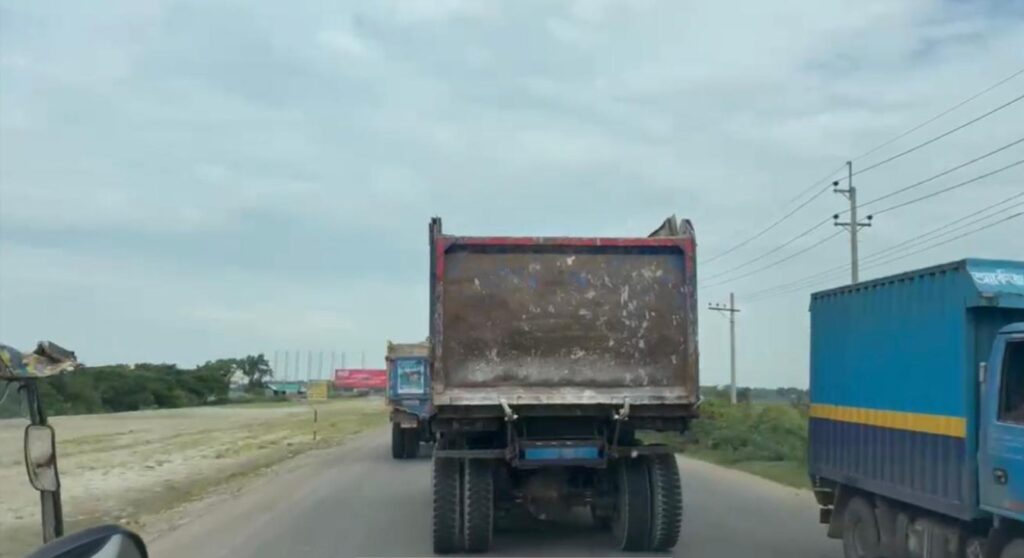
Road to Sylhet: A Vital Route That Can No Longer Be Ignored
The Dhaka-Sylhet highway is one of Bangladesh’s most important transport routes, connecting the capital with Sylhet and the wider northeastern region. Yet for many travellers today, the journey has become a test of patience, with broken road sections, potholes, construction zones and frequent traffic congestion making the trip far more difficult than it should be.
A journey between Dhaka and Sylhet that should normally take around five to seven hours can now take considerably longer. During periods of heavy traffic, particularly around Eid and other holidays, travellers have reported journeys lasting 12 to 15 hours.
For a city and region as important as Sylhet, this situation needs urgent attention.
The Dhaka-Sylhet highway needs urgent improvement
The Dhaka-Sylhet route is not simply another highway in Bangladesh. It is a vital connection for people travelling between Dhaka and the Sylhet Division, while also supporting trade, business, tourism and the movement of goods.
The approximately 209-kilometre Dhaka-Sylhet corridor is currently undergoing a major development programme intended to significantly improve the road. However, progress has been painfully slow.
Recent reports have highlighted how ongoing construction itself is contributing to congestion because traffic is being forced through narrow sections while road expansion work continues.
The Daily Star reported in March 2026 that only around 20% of the Dhaka-Sylhet highway construction had been completed.
By July 2026, another report citing an Implementation Monitoring and Evaluation Division (IMED) review said the project had completed only about 21% of its physical work despite nearly 89% of the scheduled project period having elapsed.
That should be a serious concern.
Broken roads and potholes are making the journey worse
 Construction delays are only part of the problem.
Several sections of the highway have deteriorated badly, with potholes, damaged surfaces and narrow carriageways making it difficult for buses, cars, trucks and other vehicles to maintain a reasonable speed.
One of the most notorious sections is around Ashuganj and Sarail in Brahmanbaria.
The area has repeatedly experienced severe congestion as construction, road damage and traffic management problems combine to create bottlenecks.
The Daily Star reported in May 2026 that long tailbacks had formed between Ashuganj and Sarail Bishwa Road because of ongoing four-lane construction and weak traffic management.
The Business Standard previously described the roughly 12-kilometre Ashuganj-Sarail section as a major source of misery for travellers, with vehicles sometimes taking hours to cover a relatively short distance.
More recently, reports from July 2026 described traffic jams stretching for 10 to 20 kilometres around Sarail, with large potholes and damaged sections further slowing traffic.
For passengers, this is not simply an inconvenience. It can mean missed appointments, missed trains and flights, delayed business meetings and exhausting journeys.
Construction is necessary — but the pace needs to improve
 There is no argument against improving the Dhaka-Sylhet highway.
In fact, the opposite is true.
The six-lane development project is essential for the future of the region. Modernising the highway will improve connectivity, reduce travel times and create better conditions for commercial transport.
The problem is the pace of implementation.
Travellers can see construction activity taking place in different locations, but progress often appears painfully slow. Sections are dug up, traffic is diverted and lanes become restricted, while travellers are left wondering when the finished highway will finally become a reality.
A major infrastructure project will naturally cause disruption while work is taking place. That is understandable.
What is difficult for travellers to accept is years of disruption without seeing sufficient progress towards completion.
An IMED review reported in July 2026 identified several problems affecting the project, including design issues, delays in land acquisition and difficulties relocating utilities. The review also raised concerns about potential time and cost increases.
These problems need to be addressed rather than allowed to continue indefinitely.
Sylhet deserves better connectivity
Sylhet is one of Bangladesh’s most important regions.
It is important economically, culturally, commercially and as a tourist destination.
The region is well known for its tea gardens, natural beauty, rivers, hills, haors and tourist attractions such as Jaflong, Ratargul, Lalakhal and Bichanakandi. The Bangladesh Tourism Board also lists numerous attractions across Sylhet Division.
The Sylhet Divisional administration describes the region as an important spiritual and commercial centre, while highlighting its tea production, natural resources and economic importance.
Tourism alone creates a strong argument for better roads.
In March 2025, The Daily Star reported that Sylhet was expecting between 15 and 20 lakh tourists during the extended Eid holiday, with tourism businesses expecting turnover of up to Tk 150 crore.
If millions of people are travelling to Sylhet for tourism, business and family visits, the main road connecting the region to Dhaka should provide a reliable and modern travel experience.
The highway is also important for business
Good roads are not only about passenger comfort.
They are essential for the movement of goods.
Sylhet has important tea, agricultural, energy and other industries, while the wider region is connected to major commercial routes towards Dhaka and India’s northeastern states.
A slow and unreliable highway increases transport costs and makes businesses less efficient.
Trucks carrying goods cannot operate efficiently when they spend hours stuck in traffic. Bus operators face higher fuel and operating costs when journeys take several additional hours. Passengers also lose valuable time.
Improving the Dhaka-Sylhet highway should therefore be viewed as an economic investment, not simply a road project.
The government should speed up the work
The government has already recognised the importance of the Dhaka-Sylhet corridor and invested heavily in its development.
Now the priority should be to ensure that the work is completed properly and as quickly as realistically possible.
There are several things that could make an immediate difference:
- Speed up construction on unfinished sections.
- Repair dangerous potholes and broken surfaces instead of waiting for the main project to finish.
- Keep sufficient lanes open for traffic wherever possible.
- Improve traffic management around construction zones.
- Remove unnecessary roadside obstructions and illegal parking.
- Ensure contractors meet realistic construction milestones.
- Resolve land acquisition and utility relocation problems quickly.
- Provide clearer public information about construction progress and expected completion dates.
- Give priority to particularly problematic bottlenecks such as Ashuganj and Sarail.
Travellers should not have to choose between a damaged road and a construction zone.
Six lanes will make a huge difference — if the project is completed
The Dhaka-Sylhet Corridor Road Development Project was designed to transform the existing highway and improve capacity along the route.
But infrastructure only benefits people once it is actually completed.
The latest reports are concerning because of the gap between the amount of time already spent and the amount of physical work completed.
The Daily Sun reported in 2026 that the project had progressed only slightly beyond one-fifth of its planned work despite most of the scheduled implementation period already being used.
This raises an obvious question: How much longer should travellers have to wait?
Sylhet does not need another decade of promises. It needs a safe, reliable and modern connection with Dhaka.
What is the best way to travel from Dhaka to Sylhet?
For people travelling by road, the Dhaka-Sylhet highway remains the obvious option. However, travellers should allow plenty of extra time because traffic conditions can change quickly.
The railway can be an attractive alternative, particularly for those who prefer a more relaxed journey. However, train tickets are not always easy to obtain, especially during weekends, holidays and major festivals.
This leaves air travel as the quickest and most reliable option for travellers who need to reach Sylhet on time.
A direct flight from Dhaka to Sylhet takes roughly 50 minutes to one hour, compared with several hours by road. Current schedules show multiple daily services on the Dhaka-Sylhet route from airlines including Biman Bangladesh Airlines, US-Bangla Airlines and Air Astra.
For business travellers, tourists with limited time, families travelling with children or anyone who simply wants to avoid the uncertainty of highway congestion, flying can make much more sense.
Of course, airfares can be higher than travelling by bus or train, particularly during busy periods. But when time and reliability matter, the additional cost may be worthwhile.
Dhaka-Sylhet highway: The time for action is now
Sylhet is too important to remain poorly connected.
The region contributes to Bangladesh’s economy, attracts tourists from across the country and abroad, has a large expatriate community and contains some of the country’s most recognisable natural and cultural attractions.
A modern Dhaka-Sylhet highway would benefit not only Sylhet but the entire northeastern region of Bangladesh.
Construction work is already underway, and that is encouraging. But the current pace needs to improve.
The government and the agencies responsible for the project should treat the completion of the highway as a priority. At the same time, damaged sections and dangerous potholes should be repaired immediately rather than waiting for the major project to be completed.
Sylhet deserves a road that reflects its importance.
Until that happens, travellers will continue to spend hours crawling through construction zones and damaged sections of highway.
And for those who simply cannot afford to lose half a day or more on the road, flying from Dhaka to Sylhet remains the quickest and, in many cases, the most practical option.
Leave a Reply